Checklist: Comparing wholesale building material suppliers
A wholesale building-material shortlist should compare the same product requirements, evidence, delivery, and replacement terms. A structured checklist keeps technical gaps and logistics assumptions visible before award.
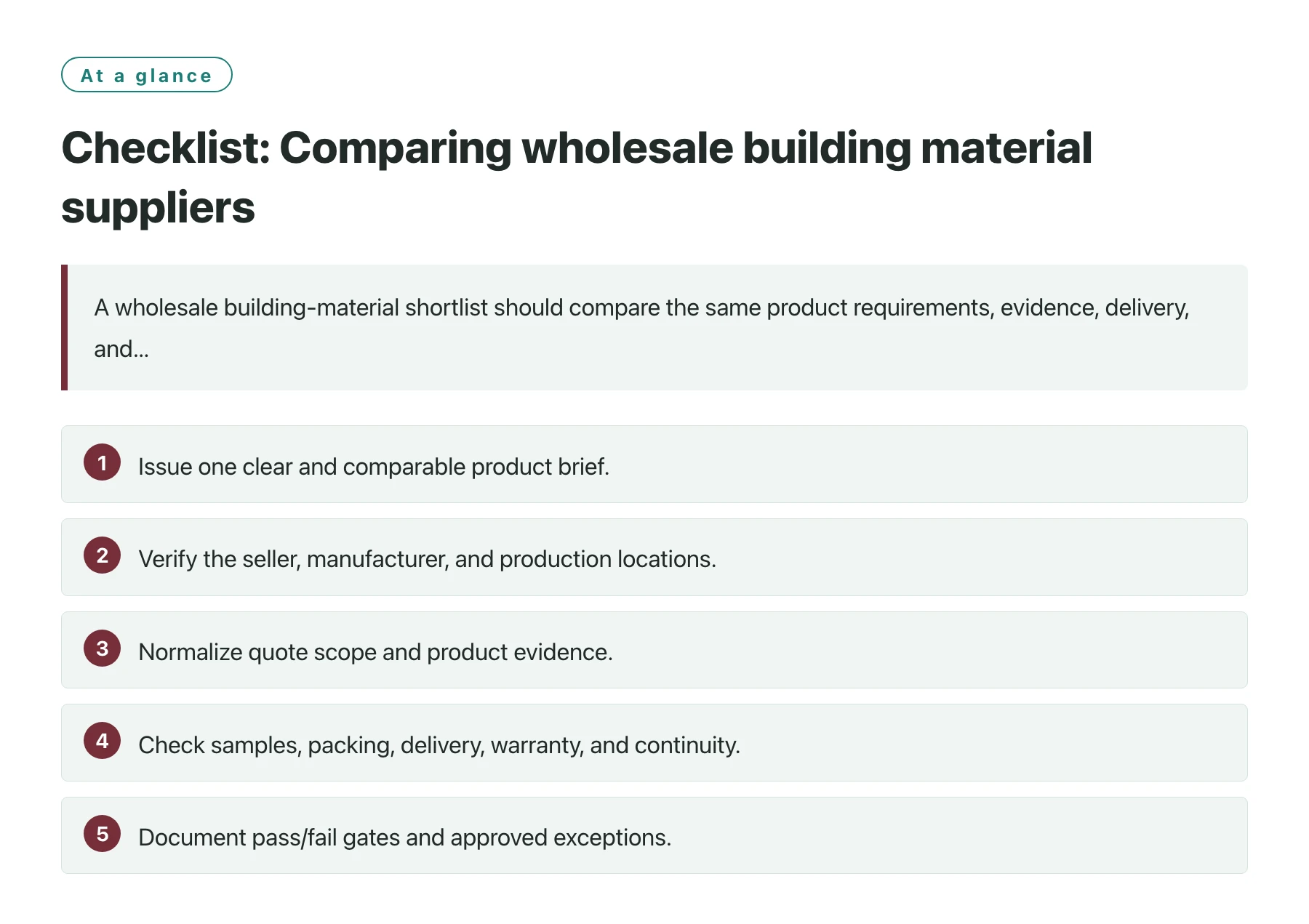
Key takeaways
- Issue one clear and comparable product brief.
- Verify the seller, manufacturer, and production locations.
- Normalize quote scope and product evidence.
- Check samples, packing, delivery, warranty, and continuity.
- Document pass/fail gates and approved exceptions.
Building products can differ in grade, finish, processing, packing, and market evidence even when their sales descriptions look similar.
1. Prepare a comparable product brief
Start with product use, project location, applicable specifications, dimensions, grade or class, surface, performance needs, quantity, delivery window, and packaging. Construction materials range from boards and tiles to hardware, panels, profiles, sanitary products, and fixtures. A common brief lets suppliers respond to the same requirement instead of quoting different assumptions.
Separate must-have requirements from preferences and permitted alternatives. Identify who confirms design values, market rules, fire or structural performance, and other specialist topics. Suppliers can suggest options, but a qualified project owner should approve their suitability for the actual application.
2. Verify the seller and manufacturer
Record legal name, contracting entity, invoice issuer, payment beneficiary, exporter, production site, and any distributor or agent. Ask which facilities perform manufacturing, finishing, testing, and packing. Confirm the relationship between seller and factory, especially when quotations use a brand or trading name.
The U.S. Department of Commerce recommends due diligence when evaluating foreign business partners. Use checks proportionate to project size and risk to verify identity, references, payment details, and material claims. Keep evidence and dates; a directory profile or website alone does not establish capability. [1]
3. Match capability to the material and project
Ask about product families, production processes, size and finish range, available capacity, minimum run, customization, lead time, and quality controls. Request evidence tied to similar materials and order scale. For a mixed order, confirm whether one company makes every line or coordinates several producers.
Identify limitations and subcontracted steps such as cutting, coating, tempering, lamination, galvanizing, or packing. Ask how drawings and revisions are controlled across locations and who is responsible if one processor changes a dimension or finish. These interfaces can affect installation and other trades.
4. Compare quotations line by line
Normalize grade, dimensions, tolerances, surface, color, quantity, packaging, samples, tooling, inspection, delivery basis, warranty, and documentation. Require a written deviation for every requirement the supplier cannot meet. Record quote revision, currency, validity, minimum order, price breaks, and lead-time trigger.
Separate material price from customization, export packing, inland haulage, freight, insurance, duties, storage, and delivery to site. Keep estimated and confirmed costs distinct. A low unit rate may rely on different specification, a larger minimum quantity, or a delivery assumption that transfers risk to the buyer.
5. Review technical and market evidence
Request product data, test reports, certificates, declarations, and installation guidance relevant to the destination and end use. Match each document to product code, factory, thickness or size, finish, sample, issue date, and scope. Identify who verifies authenticity and who decides whether the evidence meets local project requirements.
A quality-system certificate, catalogue, or generic declaration does not automatically prove every material property. Ask a qualified technical or compliance owner to identify required evidence and interpret limitations. Keep unanswered technical points separate from commercial scoring until they are resolved or formally accepted.
6. Evaluate samples and mock-ups
Label samples with supplier, model, revision, finish, batch, and date. Check dimensions, appearance, fit, edge quality, color, hardware, machining, or assembly as relevant. Compare samples under representative lighting and installation conditions when those factors change the result.
Define what sample approval covers and how production will be checked against it. A sample may be selected by hand and may not represent lot consistency. For large or custom projects, agree whether a mock-up, pilot quantity, or additional test is needed before full production.
7. Check packing, logistics, and receiving
Specify protective materials, crate or pallet style, bundle count, carton marks, gross weight, dimensions, stacking limits, moisture protection, and loading sequence. Confirm whether goods are fragile, long, heavy, or prone to surface damage and whether receiving equipment can handle each unit.
Reconcile labels and packing lists with product codes, project areas, and shipment lots. Plan receiving windows, inspection timing, storage, and damage claims. If orders are split across suppliers, coordinate delivery sequence and assign one owner to consolidate quantities and document exceptions.
8. Review service, replacement, and continuity
Ask how shortages, transit damage, defects, and changes are reported and resolved. Confirm claim window, evidence, replacement lead time, return freight, spare quantities, warranty route, and technical support contact. For materials needed to complete a project, replacement availability may matter more than a small price difference.
Assess capacity during peak periods, raw-material dependencies, alternate lines, and continuity planning. If a supplier changes plant, process, input source, or product code, require advance notification and buyer review. Keep backup options for critical products where schedule or availability risk is high.
9. Apply a consistent shortlist scorecard
Set pass/fail gates for identity, technical fit, required documents, delivery requirements, and project-critical performance. Then compare evidence quality, capacity, price, communication, warranty, replacement support, and logistics. Agree weights before scoring supplier names and note every unresolved risk.
A supplier that does not meet a mandatory requirement should not gain approval through a strong price or presentation score. Record what evidence would close each gap, who owns review, and by when. If the buyer accepts a deviation, document the affected project areas and conditions.
10. Finalize award and order controls
Before award, confirm the chosen product code, drawings, sample, quantity, package specification, delivery basis, inspection plan, warranty, and approved exceptions. Attach the final quotation and requirements to the purchase order. Name who can approve substitutions, price changes, or schedule changes.
Teams sourcing Shanghai JS Sourcing can use this checklist to compare wholesale building-material suppliers and coordinate evidence, samples, and deliveries. Confirm current service terms directly and preserve the project owner’s authority over design, compliance, and final acceptance.
Sources
Frequently asked questions
What should I compare between wholesale building-material suppliers?
Compare product fit, factory identity, evidence, capacity, quote scope, packing, delivery, warranty, and replacement terms.
Is a low unit price enough to select a materials supplier?
No. Normalize specification, quantity, exclusions, logistics, project handling, and the cost of defects or replacement.
What documents should suppliers provide?
Request product-specific technical data and any market or project evidence identified by qualified design and compliance owners.
How can I keep multi-supplier material deliveries organized?
Use shared product codes, carton marks, packing lists, delivery windows, quantity reconciliation, and named issue owners.