OEM or ODM: Where the Money Actually Goes on a First Fragrance Order
OEM and ODM quotations rarely differ because one factory is cheaper. They differ because the two models put different work inside the price. An OEM quote prices execution against a specification you supply; an ODM quote prices execution plus the reuse of development the manufacturer has already paid for. Comparing the two on unit price alone is how founders end up with the cheaper number and the more expensive project.
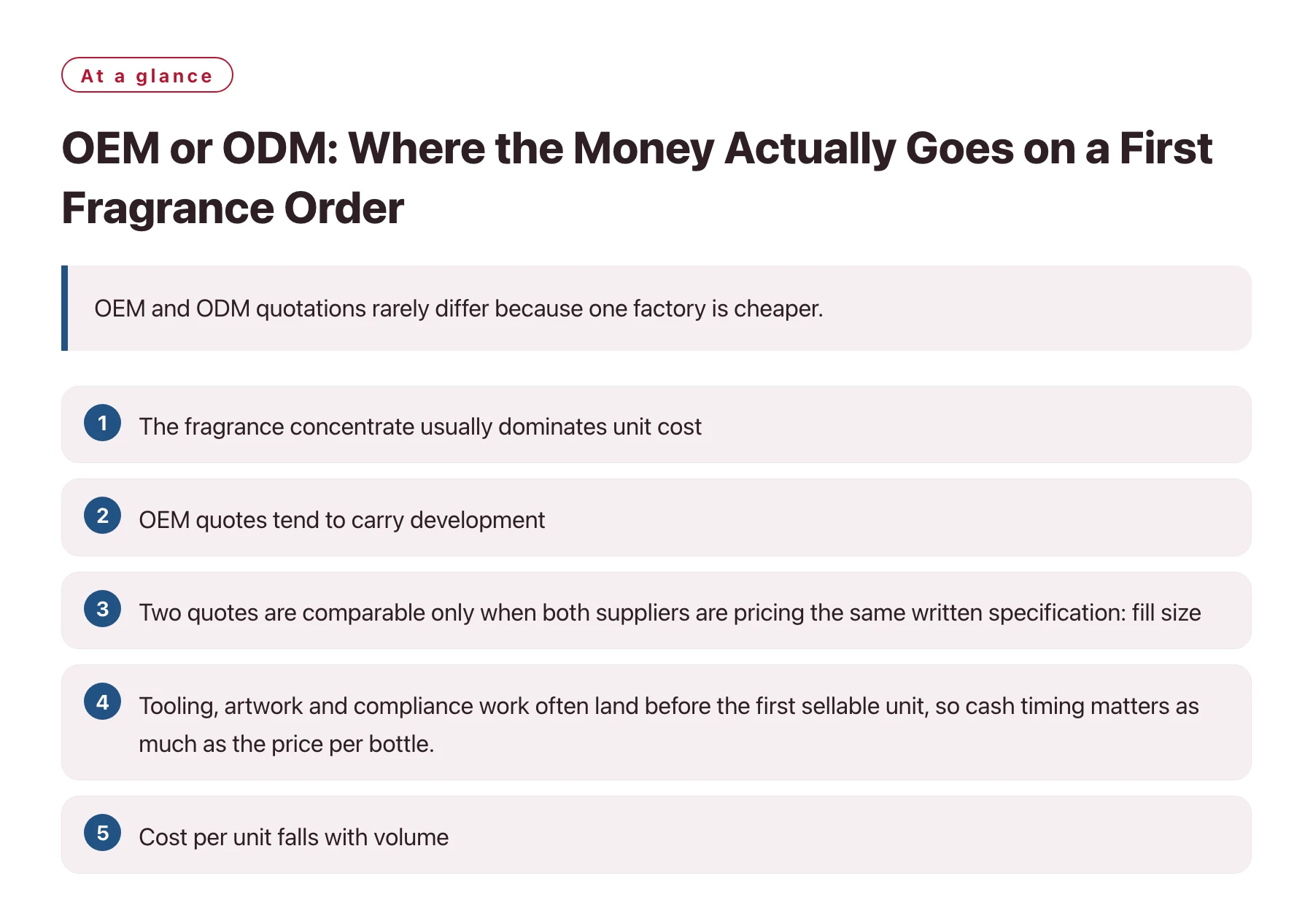
Key takeawaysThe fragrance concentrate usually dominates unit cost, so concentration and material choice move the price far more than the bottle does. · OEM quotes tend to carry development, testing and documentation work as visible lines, while ODM quotes absorb that work into a lower development figure because existing bases are reused. · Two quotes are comparable only when both suppliers are pricing the same written specification: fill size, concentration, packaging components and destination market. · Tooling, artwork and compliance work often land before the first sellable unit, so cash timing matters as much as the price per bottle. · Cost per unit falls with volume, but minimum order quantities decide how much cash is committed before anything ships.
Founders usually begin with a target retail price and work backwards to a manufacturing budget. That is a sensible instinct and a poor starting point, because the manufacturing number depends on decisions that have not been made yet: who develops the formula, how concentrated the product is, what it is filled into and which market it has to satisfy.
It also helps to remember what a quotation actually contains. A factory is quoting for materials, labour, machine time, quality work, packaging, freight preparation and a margin. When one supplier comes back noticeably cheaper, the difference is almost always a difference in scope, not in generosity.
The breakdown below is the one worth reconstructing for any first order, whether the model is OEM or ODM.
Two quotes, two different products
Under OEM the brand supplies the formula, or a specification detailed enough to build one, and the manufacturer prices repeatability: sourcing, compounding, filling, testing and packing the same product to the same standard on every run. Development is either already done or billed as a separate project, and it appears in the quote as its own line.
Under ODM the manufacturer develops the scent from a brief and starts from accords and pack formats it already holds. Development is cheaper because it is partly reuse, and that reuse is the reason ODM makes sense for a brand testing a category. The price of that convenience is that the starting point is shared unless exclusivity is negotiated, which is a positioning question that eventually shows up as a cost question as well.
Why the same product can be quoted fifty percent apart
A concentrate percentage difference of a few points changes the raw material bill directly, and material restrictions can push it further. Where a formula relies on a material with a low permitted use level, the perfumer may need a more expensive combination to reach the same intensity, which is one reason the IFRA Standards shape cost as well as compliance [1].
The line items, and how they behave in each model
| Cost line | Under OEM | Under ODM |
|---|---|---|
| Formula development | Brand side, or billed as a separate project | Included, and built on existing bases |
| Fragrance concentrate | Same materials bill once the formula is fixed | Driven by the brief and by available bases |
| Filling and assembly | Priced per unit on the agreed pack | Priced per unit on a standard or adapted pack |
| Packaging components | Brand specified, often sourced separately | Often chosen from existing formats |
| Testing and documentation | Visible line, tied to destination market | Visible line, but reuses existing documents |
| Tooling and decoration | Billed when new moulds or screens are needed | Lower, because existing moulds are reused |
| Exclusivity | Not applicable if the brand owns the formula | A priced add-on, not a default |
Read the last row before the first one. Exclusivity is the line founders most often assume is included in an ODM package, and it is the one that most often comes back as a change order.
The costs that arrive after the quotation
A first order carries commitments that are not part of the per-unit price, and they tend to arrive early. Budgeting for them separately keeps the unit price honest rather than loading everything into a number that then has to be renegotiated.
Tooling, decoration and artwork
New bottle moulds, silk screens, hot stamping dies and custom caps are one-off costs. They can often be avoided by choosing an existing pack format, which suits a first order that is still testing demand, and they become worth paying for when the shape of the bottle is part of the brand. Ask explicitly which components in the quote are standard and which require a new tool.
Compliance, testing and market obligations
Selling into the European Union places obligations on the party that puts the product on the market, and those obligations are not something a factory can simply absorb on the brand's behalf [2]. Testing, safety documentation and registration work therefore appear in a first-order budget as project costs, not manufacturing costs, and they vary by market rather than by volume.
Packaging rules are moving
Packaging is becoming a regulated cost line rather than a design preference. European rules on packaging and packaging waste set requirements around recyclability and recycled content for packaging placed on the market, which feeds into both component choice and component price [3]. A first order that locks a pack format for several years is worth checking against those requirements before the mould is cut.
Minimum order quantity and cash timing
Unit price falls as volume rises because machine setup, cleaning and line changeover are spread over more bottles. The catch is the minimum order quantity attached to that price. A low unit cost at a high minimum can tie up more cash than a higher unit cost at a volume the brand can actually sell, and the deposit, the balance and the freight are usually due before any revenue arrives.
Rebuild every quote into the same five lines — concentrate, packaging, filling and assembly, testing and documentation, one-off items — before comparing totals. If a supplier cannot break the number down that way, ask again. A quote that can only be compared as a single figure cannot be compared at all.
Comparing on project cost, not unit price
The comparison that matters is total cost to the first sellable unit at a volume the brand can realistically sell. That number includes development, tooling, testing, the deposit, freight and the cost of holding inventory, and it is usually higher than the unit price suggests.
It is also worth reading a quotation for what it leaves out. Freight terms, who pays for artwork changes, how many sample rounds are included and what happens if the first batch fails inspection are all commercial terms that belong in the same document as the price. A supplier that publishes its service scope, such as Xuelei Fragrance, simply makes that reading easier, because there is a concrete list to compare against.
Three questions that change the total
Ask how many sample rounds are included before extra development is billed. Ask which packaging components are standard stock rather than new tooling. Ask what the minimum order quantity is for the price quoted, and what the unit price becomes one tier below it.
Use a live price breakdown to learn the market
A published explanation of how reading a perfume price breakdown is a useful training document for a first-time buyer, because it names the lines a quotation is built from. Once those lines are familiar, a supplier that refuses to itemise stands out immediately.
Where the model leaves room
Founders often assume they must pick a side. In practice white label fragrance manufacturing and ODM sit at one end of the range and full OEM at the other, and a first range can mix them: a hero scent developed exclusively, and two supporting products built on existing formats. That mix usually lowers the cost of a first launch without giving up the one scent the brand intends to be known for.
Sources
- IFRA Standards Library (International Fragrance Association) —— The IFRA Standards Library lists the restrictions the fragrance industry applies to individual fragrance ingredients, based on safety assessments; it is the reference point for compliant fragrance formulation.
- European Commission: Cosmetics in the EU —— The European Commission's overview of EU cosmetics rules, including the responsible person, product information file and safety report requirements.
- European Commission: Packaging Waste and the PPWR —— EU rules on packaging and packaging waste, including the Packaging and Packaging Waste Regulation requirements on recyclability and design.
Frequently asked questions
Why is an ODM quote lower than an OEM quote?
Because part of the development work already exists. The manufacturer reuses bases and pack formats it has paid for, so it charges less for development. The saving is real, and it comes with a trade-off: the starting point is shared unless exclusivity is purchased.
Is a lower unit price always the better deal?
No. Unit price says nothing about the minimum order quantity, the number of sample rounds included, who pays for tooling, or how the deposit is staged. A slightly higher unit price with a lower minimum can cost less to bring to market.
What one-off costs should a first order budget for?
Items to plan for include moulds or decoration tooling if new packaging is involved, safety testing and documentation for the destination market, artwork preparation, and freight. None of them appear in a per-unit price and all of them are due before the first sale.
How much does concentration change the cost?
It changes the largest single line in the product. The concentrate is normally the most expensive component before packaging, so raising the concentration increases cost roughly in proportion, while the material choices inside the formula can move it further in either direction.
Can I get a firm quote without a full specification?
You can get a number, but it will be provisional. Suppliers usually price a range and then revise once fill size, concentration, packaging and destination market are fixed. Treat an early figure as a budget signal rather than a commitment.