0.005 BTC as a Withdrawal Line for a Single Rig
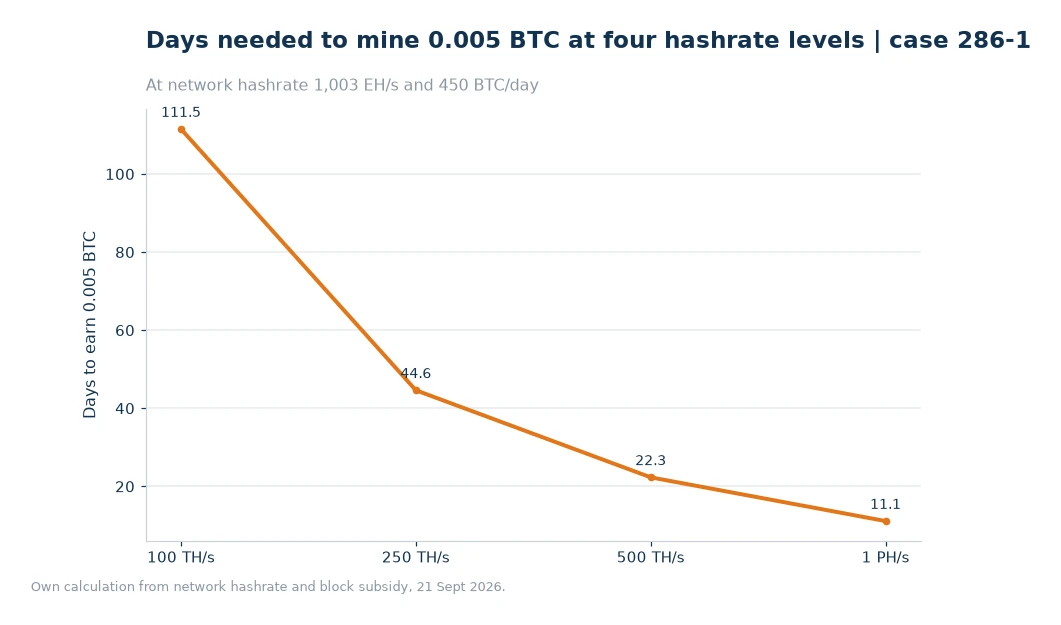
Some miners plan by date, others by amount, and a single machine usually suits the second approach. Half a hundredth of a bitcoin is worth about $423.46 at $84,692, and reaching it takes 111.5 days at 100 TH/s, 44.6 at 250 TH/s and 22.3 at 500 TH/s. A fixed coin line turns an unpredictable calendar into a simple yes-or-no check.
Key takeaways
- 0.005 BTC equals $423.46 at the 21 Sept 2026 price, regardless of which machine produces it.
- At 100 TH/s the wait is 111.5 days, so a threshold plan should be measured in months, not weeks.
- At 1 PH/s the same line arrives in 11.1 days, which makes it a monthly rather than quarterly check.
- PPS+ credits the block-reward component hourly, so the balance climbs in small steps even on a single rig.
Why a threshold beats a calendar date
A date assumes the network stands still. Difficulty does not, and a machine that loses a day to a failed fan or a heat wave will miss a calendar target through no fault of the pool. A coin threshold absorbs both: the date moves, the target does not. For anyone running one or two machines, that is a much calmer way to measure progress, and it survives a month of poor weather without any revision.
The threshold also decides when a withdrawal is worth making. Set it once, then leave it alone. Every transfer resets the count, so a miner who withdraws at random intervals never sees the line completed and never gets the sense of a finished cycle. The discipline is in the number, not in the watching. The multi-currency wallet balance is the place to watch it, since that is where a completed threshold sits before it moves.
There is a behavioural benefit as well. Daily income at 100 TH/s is about $3.80, and watching a number that small crawl upward invites the kind of tinkering that makes performance worse: restarts, overclocking experiments, pool hopping. A quarterly line removes the temptation because there is nothing to react to on any given afternoon, and nothing to undo the following morning.
The arithmetic behind 0.005 BTC
The calculation needs three inputs: the network's daily production, your hashrate, and the target. The network mints 450 BTC a day at 1,003 EH/s, which works out to 0.00000044865 BTC per terahash per day. Multiply by the machine's terahash to get a daily figure, then divide the target by that figure. The answer is a count of days at today's difficulty.
Worked this way, the fortnightly view becomes obvious. At 250 TH/s a two-week run yields 0.00157 BTC, about 31% of the 0.005 target, and four such runs plus a few extra days complete it. That intermediate checkpoint is useful for sanity: if the balance after fourteen days is far below 0.00157, the machine is not running at its rated hashrate, and the gap is worth investigating before the quarter ends.
Two details are easy to miss. The first is that the daily figure already includes the listed 4% rate on the block-reward component under PPS+, so there is no second deduction to apply. The second is that a difficulty change alters the daily figure for every machine on the network at once, which is why a long threshold plan should be revisited after each adjustment rather than treated as fixed.
Four machines, four waits
The rows below hold difficulty constant and vary only the hardware. The dollar column translates one day of output, not the target, so the two are easy to keep apart.
| Machine | BTC per day | Days to 0.005 BTC | One day is worth |
|---|---|---|---|
| 100 TH/s | 0.00004486 | 111.5 | $3.80 |
| 250 TH/s | 0.00011215 | 44.6 | $9.50 |
| 500 TH/s | 0.00022430 | 22.3 | $19.00 |
| 1 PH/s | 0.00044861 | 11.1 | $37.99 |
The pattern is clean: every doubling of hashrate halves the days. What the table cannot show is the cost of getting there. A 100 TH/s machine that draws 3 kW uses 72 kWh a day, and at $0.06 that is $4.32 against $3.80 of coin. The threshold still arrives, but the electricity bill may arrive faster, which is a separate problem from the schedule.
Worked example
Take the 250 TH/s row and check every step.
- Network rate per TH/s: 450 ÷ 1,003,000,000 = 0.00000044865 BTC daily.
- At 250 TH/s: 250 × 0.00000044865 = 0.00011215 BTC a day.
- Days to the line: 0.005 ÷ 0.00011215 = 44.6 days.
- Cross-check at 1 PH/s, four times the hashrate: 0.00044861 a day, so 0.005 ÷ 0.00044861 = 11.1 days.
- Value of the target: 0.005 × 84,692 = $423.46.
- Value of one day at 250 TH/s: 0.00011215 × 84,692 = $9.50.
Pool Hashrate and Pool Luck at small scale
A single machine is a rounding error in a pool that spans 150+ countries, and that is the point of joining one. Pool Hashrate tells you how large the collective is; Pool Luck tells you how its recent block discovery compares with expectation. Neither number changes what your rig earns under PPS+, and both are worth a glance when something looks off.
The ViaBTC BTC Mining Pool page is where those figures live. For a small operator the useful habit is a weekly look, not a daily one. A pool's share of the network moves slowly, and a luck reading over a few hours is mostly noise. Checking weekly keeps the picture honest without turning it into a distraction.
What a price move does to the plan
The coin target is independent of price; the dollar value is not. At $84,692, 0.005 BTC is $423.46. If the price halves, the same threshold is worth roughly $211.73, and the electricity bill has not moved. That asymmetry is why a threshold plan should be paired with a power budget rather than read as an income forecast.
It also explains why some miners prefer to think in coin and others in currency. Neither is wrong. A coin threshold answers "how much did the machine produce"; a currency budget answers "did the operation cover its costs". Keeping both numbers visible stops one from being mistaken for the other, which is the most common error in a single-rig setup and the easiest one to correct with two columns in a notebook.
A practical compromise is to set the coin line and a power ceiling side by side. The coin line decides when to withdraw, the ceiling decides when to switch the machine off. Neither figure needs updating more than once a quarter, and together they answer the two questions a small operator actually faces: is it producing, and is it worth running.
Frequently asked questions
How long does 0.005 BTC take on one machine?
At 100 TH/s it takes 111.5 days, and at 250 TH/s it takes 44.6 days. The wait depends on hashrate and difficulty, not on the coin's dollar price.
Should I withdraw as soon as the threshold is reached?
Mining payouts carry no fee, so the threshold is a convenience rather than a cost saving. Withdraw when the balance suits your records; the chain's confirmation time is the only delay.
Does Pool Luck affect a single rig on PPS+?
No. The block-reward component is settled hourly against current difficulty, so the pool's lucky or unlucky streaks leave a PPS+ credit untouched.
Choose the line, then stop watching daily
Pick a number you can hold in your head, write it beside the machine's daily output, and divide once. At 250 TH/s that is 0.005 ÷ 0.00011215, or 44.6 days. Then check weekly instead of hourly, and let the balance do the work. A threshold is only useful if it reduces the number of decisions, so the last step is to stop making them.
Sources: pool state and pricing pages at viabtc.com, covering Pool Hashrate, Pool Luck and the 4% block-reward rate[1]. The 21 Sept 2026 reading gave 1,003 EH/s of network hashrate, 132.76 T difficulty and $84,692 per BTC; article published 24 Oct 2026, with day counts assuming stable difficulty.