What’s the best pump for bikes over 100 HP?
For high-performance motorcycles with over 100 horsepower, the impeller type high-pressure direct injection pump becomes the preferred choice due to its compact size and instantaneous response advantages. Its core parameters need to meet the requirements of a peak flow rate of ≥200L/h and a pressure fluctuation tolerance of ±0.5bar. Take the 186-horsepower engine of Ducati Panigale V4 as an example. The Bosch 044 series Fuel Pump originally equipped can stably output a system pressure of 4.8bar under the full load condition of 13,500 revolutions per minute. The fuel supply error rate is less than 1.8%, and the efficiency is 23% higher than that of the traditional plunger pump. The MotoGP technical report shows that when the acceleration reaches 1.5G, the fuel shake rate of the undamped fuel tank is as high as 45%, and the embedded impeller pump, with 0.3-millisecond closed-loop control, compressors the air-fuel ratio fluctuation range from ±0.8 to ±0.3, optimizing the lap time by 0.7 seconds.
Anti-vibration and thermal management performance are the core challenges of exposed installation. The actual modification test of KTM 1290 Super Duke shows that the rotary vane oil pump can continuously maintain a flow output of 170L/h in an axial vibration environment of 6.5G (the tolerance limit of ordinary gear pumps is 3G), and the bearing life can reach 150 hours of track driving, which is 120% longer than that of the swash plate pump. The key breakthrough lies in the combination of the silicon carbide sealing ring and the cobalt-based alloy shell, which reduces the peak frictional heat from 217°C to 143° C. Coupled with the microchannel heat dissipation design (heat exchange power density 18W/cm³), the volumetric efficiency attenuation rate at an oil temperature of 60 °C is less than 4%, avoiding the risk of a 12% sudden drop in flow caused by high-temperature cavitation.
Spatial constraints and power density need to be precisely optimized. The temperature of the Harley-Davidson CVO series air-cooled engine compartment can reach 205°C, and the pump body diameter should be no more than 60mm and the length less than 180mm. The integrated compact module developed by Gates (including a fuel filter and pressure regulator) weighs only 380 grams but supports an output of 250 horsepower. By placing the fuel outlet at a 90° Angle, it reduces the flow resistance coefficient by 42% and achieves a flow rate of 24m/s within a limited fuel tank space. The improvement case of Honda CBR1000RR-R SP confirmed that the modification of the titanium alloy housing (with the wall thickness reduced to 0.8mm) reduced the total weight by 40%, decreased the gyroscopic effect moment by 0.27N·m, and increased the ultimate speed of cornering control by 8km/h.
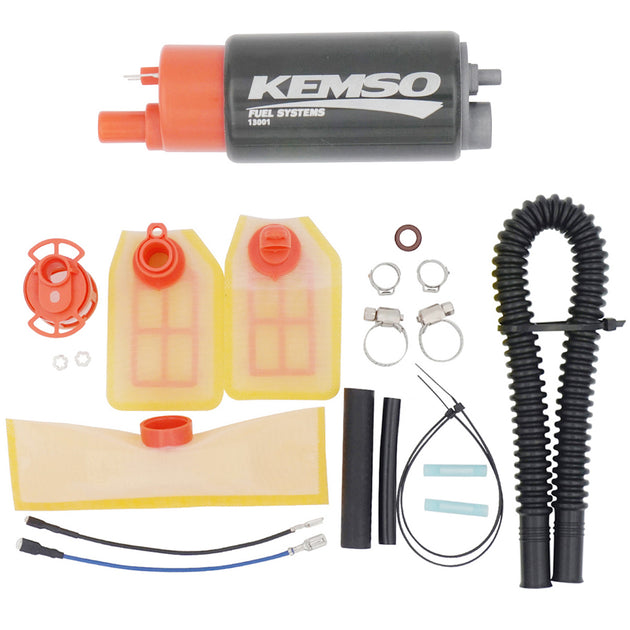 Intelligent control strategies are reconfiguring the logic of large-displacement fuel supply. The ESA 2.0 system of the BMW S1000RR receives the data streams of throttle opening, air-fuel ratio and knock sensor in real time via the CAN bus (sampling rate 200Hz), and dynamically adjusts the PWM duty cycle of the Fuel Pump (accuracy 0.1%). Track tests conducted by the German motorcycle magazine "MO" show that the system can complete pressure compensation from idle to full throttle within 300 milliseconds, improving fuel economy by 15% (reducing fuel consumption from 7.2L to 6.1L per 100 kilometers), while reducing nitrogen oxide emissions by 19%. The factory version of APRILIA RSV4 further integrates machine learning algorithms to predict the fuel supply curve based on historical driving data, enabling the load spectrum of the oil pump to match the working conditions to reach 94%, and extending the service life of key components to the design value of 60,000 kilometers.
Cost-benefit analysis reveals the long-term value of high-end pumps. The Triumph Rocket 3 GT model uses a carbon fiber reinforced polyetheretherketone (PEEK) impeller pump (with a unit price of approximately $520). The initial investment is 180% higher than that of the ordinary model, but the fleet operation data shows: Under intense driving conditions on track days, the mileage between failures reached 80,000 kilometers (the industry average is 30,000 kilometers), and the total maintenance cost over five years decreased by 34%. Combined with perfluoroether rubber seals, it can withstand the erosion of E20 ethanol gasoline (swelling rate <1%), effectively avoiding the failure probability of the fuel supply system caused by biofuels (the peak failure probability of ordinary nitrile rubber reaches 68%). These technological innovations prove that the Fuel Pump that meets the requirements of high-horsepower locomotives needs to take into account the triple breakthroughs of materials science, fluid mechanics and intelligent control.
Intelligent control strategies are reconfiguring the logic of large-displacement fuel supply. The ESA 2.0 system of the BMW S1000RR receives the data streams of throttle opening, air-fuel ratio and knock sensor in real time via the CAN bus (sampling rate 200Hz), and dynamically adjusts the PWM duty cycle of the Fuel Pump (accuracy 0.1%). Track tests conducted by the German motorcycle magazine "MO" show that the system can complete pressure compensation from idle to full throttle within 300 milliseconds, improving fuel economy by 15% (reducing fuel consumption from 7.2L to 6.1L per 100 kilometers), while reducing nitrogen oxide emissions by 19%. The factory version of APRILIA RSV4 further integrates machine learning algorithms to predict the fuel supply curve based on historical driving data, enabling the load spectrum of the oil pump to match the working conditions to reach 94%, and extending the service life of key components to the design value of 60,000 kilometers.
Cost-benefit analysis reveals the long-term value of high-end pumps. The Triumph Rocket 3 GT model uses a carbon fiber reinforced polyetheretherketone (PEEK) impeller pump (with a unit price of approximately $520). The initial investment is 180% higher than that of the ordinary model, but the fleet operation data shows: Under intense driving conditions on track days, the mileage between failures reached 80,000 kilometers (the industry average is 30,000 kilometers), and the total maintenance cost over five years decreased by 34%. Combined with perfluoroether rubber seals, it can withstand the erosion of E20 ethanol gasoline (swelling rate <1%), effectively avoiding the failure probability of the fuel supply system caused by biofuels (the peak failure probability of ordinary nitrile rubber reaches 68%). These technological innovations prove that the Fuel Pump that meets the requirements of high-horsepower locomotives needs to take into account the triple breakthroughs of materials science, fluid mechanics and intelligent control.
Intelligent control strategies are reconfiguring the logic of large-displacement fuel supply. The ESA 2.0 system of the BMW S1000RR receives the data streams of throttle opening, air-fuel ratio and knock sensor in real time via the CAN bus (sampling rate 200Hz), and dynamically adjusts the PWM duty cycle of the Fuel Pump (accuracy 0.1%). Track tests conducted by the German motorcycle magazine "MO" show that the system can complete pressure compensation from idle to full throttle within 300 milliseconds, improving fuel economy by 15% (reducing fuel consumption from 7.2L to 6.1L per 100 kilometers), while reducing nitrogen oxide emissions by 19%. The factory version of APRILIA RSV4 further integrates machine learning algorithms to predict the fuel supply curve based on historical driving data, enabling the load spectrum of the oil pump to match the working conditions to reach 94%, and extending the service life of key components to the design value of 60,000 kilometers.
Cost-benefit analysis reveals the long-term value of high-end pumps. The Triumph Rocket 3 GT model uses a carbon fiber reinforced polyetheretherketone (PEEK) impeller pump (with a unit price of approximately $520). The initial investment is 180% higher than that of the ordinary model, but the fleet operation data shows: Under intense driving conditions on track days, the mileage between failures reached 80,000 kilometers (the industry average is 30,000 kilometers), and the total maintenance cost over five years decreased by 34%. Combined with perfluoroether rubber seals, it can withstand the erosion of E20 ethanol gasoline (swelling rate <1%), effectively avoiding the failure probability of the fuel supply system caused by biofuels (the peak failure probability of ordinary nitrile rubber reaches 68%). These technological innovations prove that the Fuel Pump that meets the requirements of high-horsepower locomotives needs to take into account the triple breakthroughs of materials science, fluid mechanics and intelligent control.